
LOS ANGELES – It wasOpening Day at Dodger Stadiumon March 26, and a pregame ceremony paused as fans waited for the arrival of the two World Series trophies theLos Angeles Dodgershad won the past two seasons.
Finally, ablue Cadillac lowrider driven by actor Will Ferrellparted the center-field gate and pulled onto the warning track. Two of the car's occupants were the World Series trophies, and up went cheers, especially from thousands of Latinos in the Pavilion section beyond the outfield walls.

"That's how you got to do it in L.A.," declared Matthew Oviedo, 32, who grew up in East Los Angeles, one of the prominently Latino communities where lowriders were popularized.
Latinos make up about 40% of the Dodgers fanbase. But like the team, the city in which they play and America at large, Dodger fans are an ethnic melting pot – White, Asian, Black and Latino. Heritage Nights have become popular for MLB teams celebrating different cultures, and this season the Dodgers have scheduled seven – one night each for Japanese, Mexican, Filipino, Black, Guatemalan, Salvadoran and Korean cultures.
As America's 250th anniversary approaches, the Dodgers provide a powerful lens through which to view the country's history − specifically, issues of social migration, civil rights and immigration.
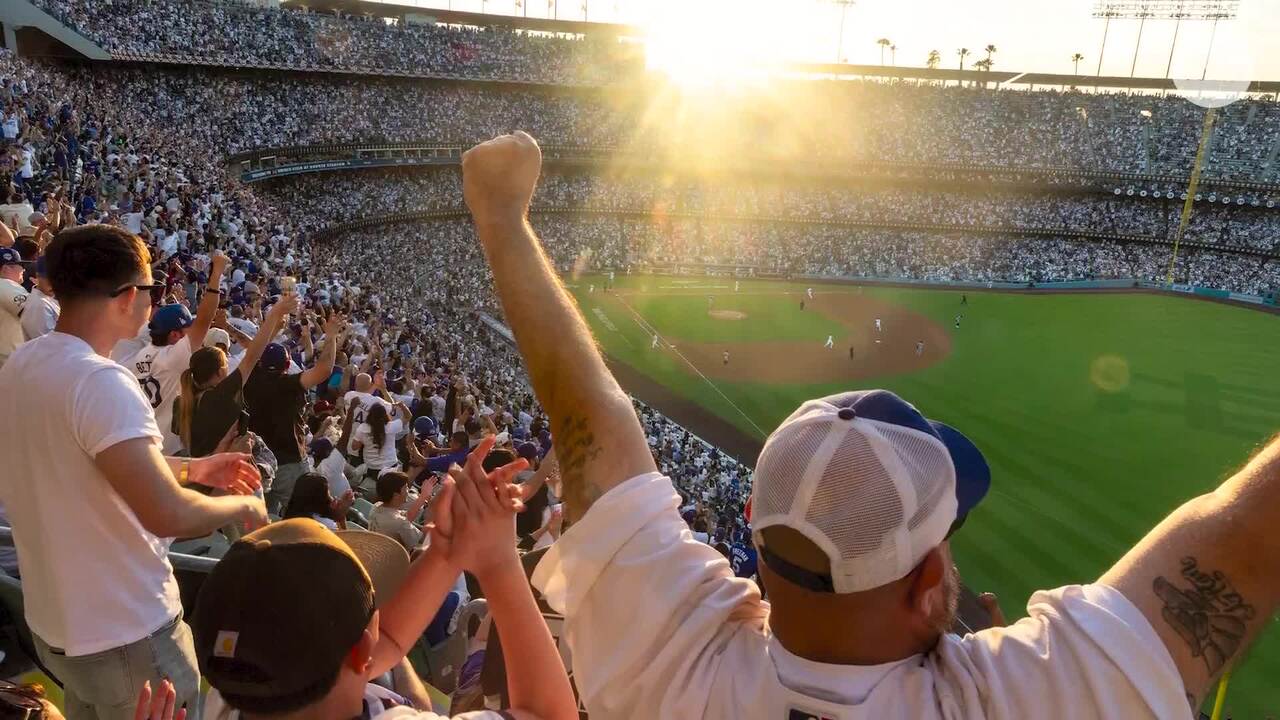
In the past 10 months, Dodger Stadium has been used for celebrations and protests. Celebrations of the team's success as the Dodgers seek a third straight World Series title. And protestscalling for the team to reject the Trump administration's immigration policydisproportionately impacting Latinos.
The stadium also happens to be built on land where families, mostly Mexican-American, wereuprooted from their homesin the name of progress. The estimated number of families who lived on the land range from300 to more than 1,800in the years before Dodger Stadium was built.
"We're standing in somebody's backyard," Richard Moreno, 46, a self-described superfan also known as"Mariachi Loco,"told USA TODAY inside the stadium on Opening Day. "It hurts, but what can you do?''

A star is born running from oppression
Steam billowed into the sky as trains chugged across America.The Great Migrationwas underway.
Between 1910 and 1970, an estimated 6 million Black residents left the South for other parts of the country, according to theU.S. Census Bureau. They were running from racial violence, segregation and economic oppression.
"They found the courage within themselves to break free," author Isabel Wilkerson wrote for the Smithsonian magazine.
In late spring of 1920, a Black woman boarded a train in Cairo, Georgia, and embarked on a trip of more than 2,200 miles to Pasadena, California. Her husband had left the family and she was traveling with their five children, the youngest a boy about 16 months old.

His name wasJack Roosevelt Robinson. But America would know him as Jackie Robinson, the baseball player who broke the Major League color line in 1947 as a member of the Brooklyn Dodgers.
In 1919, the year Jackie Robinson was born in Georgia, theNAACPpublished a booklet entitled "Thirty Years of Lynching in the United States: 1889-1918." The organization reported there had been 386 lynchings in Georgia, second most only to Mississippi among U.S. states during that 30-year period.
Robinson's parents, Mallie and Jerry, were sharecroppers who lived in shack-like conditions on the Sasser plantation in southeastern Georgia. After Jerry Robinson left the family, Mallie Robinson took them to Pasadena, then an affluent city 20 miles from Los Angeles where some of her relatives lived.
"It was a fairly decent-looking community," said Okeyo Jumal, 82, a Black historian from Pasadena. "And we knew that because people who came out later on (from the South) would say, 'This is a Black community? This is a nice-looking community to be a Black community.'"
But the municipal pool in Pasadena was open to non-Whites only one day a week. Black residents watched movies from segregated balconies. Their economic opportunities were limited.
Mallie Robinson worked as a maid, saved her modest wages and bought a four-bedroom clapboard house at121 Pepper St. Jackie Robinson had a group of interracial friends called "The Pepper Street Gang'' and between 1938 and 1941 he was a four-sport star atPasadena Junior Collegeand then atUCLA.
"Even with his prodigious athletic talent, his opportunities would've been circumscribed in the South by racism," said William Deverell, a University of Southern California (USC) professor and historian who lives in Pasadena. "So coming here and going to Pasadena City College and going to UCLA, it's not perfect by any means, but it's a lot better (than Georgia). I think that opened the doors for his rise to athletic fame."
In short, the Great Migration may have carved a path for the most significant player in baseball history.
Bigger than baseball: Jackie Robinson, White allies and fan integration
Black soldiers returned home from World War II in 1945 angry about having fought oppression abroad only to encounter it again at home. They demanded equal rights.
But U.S. armed forces and public schools remained segregated. Major League Baseball clung to an unwritten rule banning Black players. Under that backdrop, Robinson broke baseball's color line on April 15, 1947, as part of an unlikely partnership.

Branch Rickey, then the Dodgers' president and general manager, was largely responsible for signing Robinson. He wore bow ties, smoked cigars and was determined to win. He was 65.
Robinson impressed reporters with his intelligence and remained calm in the face of racist taunts and threats. He was 28.
"Those two men took it to another level," Della Britton, president and CEO of theJackie Robinson Foundation, told USA TODAY Sports. "It worked because Branch Rickey had the gumption to do it and it worked because Jackie followed up."
Of Rickey, Britton added, "It took White allies to create progress and to agitate and move the country forward."
The Dodgers, at risk of alienating their fans and fellow teams, gave Robinson a chance. He turned it into something bigger.
Yes, he won the inaugural Rookie of the Year award in 1947, was named National League MVP in 1949 and in 1955 helped lead the Dodgers to their first World Series title. By then, however, he also had emerged as a national figure speaking out about equal rights.
"Robinson is not just a symbol of integration in America," Johnny Smith, a professor and sports historian at Georgia Tech University, told USA TODAY. "He is a crucial actor, an agent of change, a crucial voice."
Pete Hamill, the late journalist who grew up in Brooklyn, said the Dodgers integrated not only their team but also their fans.
"You could be an Irishman, an Italian, and a Jew, and you could all be in Ebbets Field, sitting together, rooting for the Dodgers." Hamill told Brian Purnell, author of "Fighting Jim Crow in the County of Kings."
"…we became the most American place in the country," Hamill told Time magazine.
During Robinson's rookie year, the Dodgers drew 1.8 million, their highest season attendance at that point.
'The boom is thrilling': Dodgers look to baseball's western frontier
As if fueled by another gold rush, California's population grew by almost 50% between 1950 and 1960.
"We're in the Cold War and the federal government begins to start to pour money into defense and aeronautics and aerospace, and Southern California is the chief site of that," said Deverell, the USC professor. "Even with the trepidations of the Cold War, the economic boom and the technological boom is thrilling."
Amid those dynamics, Los Angeles officials courted a potential resident: Walter O'Malley, then owner of the Brooklyn Dodgers.
O'Malley rebuffed the initial overtures. But his efforts to find a site in New York on which to build a newer and bigger stadium than Ebbets Field in Brooklyn failed. And his interest in Los Angeles and a roughly 300-acre site for a new stadium climbed.
Advertisement
Because there were no major league teams in California, O'Malley's son and former Dodgers owner Peter O'Malley said he researched attendance figures of minor-league teams in the L.A.-area and was concerned.
"I remember saying, 'Dad, I've looked at these Coast League attendance figures for the Hollywood Stars and the L.A. Angels,'" Peter O'Malley told USA TODAY. "'Are you sure MLB is going to be embraced?'"


From Trolleys to Tinseltown: Follow the Dodgers' baseball run through the ages
On April 18, 1958, the Dodgers made their home debut in Los Angeles Memorial Coliseum, the team's temporary home. They drew a crowd of 78,672, then a record for a regular-season game, and beat the San Francisco Giants 6-5.
The Giants had also relocated from New York between the 1957 and 1958 seasons.
In Brooklyn, the Dodgers never drew more than 1.8 million fans in a season. In Los Angeles, they drew more than 2 million fans seven times in their first nine seasons. The Dodgers seemed to be riding one wave while creating one of their own.
By 1969, California had five MLB teams – the Giants, Oakland A's, California Angels, San Diego Padres and the Dodgers, who have remained among the MLB leaders in attendance.
'They'll be mad forever': Chavez Ravine's displaced communities
Based on the U.S. Census, the number of Mexican immigrants in the U.S. tripled between 1910 to 1930 to 600,000. For these families, finding affordable housing in Los Angeles involved resourcefulness.
About five decades before the Dodgers relocated to Los Angeles, impoverished Mexican families began moving onto land with modest homes and dirt roads. The property became known as Chavez Ravine, and the population grew to at least hundreds of families.
There was a grocery store, churches and an elementary school. But with the promise of federal funds to build public housing, the city of Los Angeles used eminent domain to force out residents. The city of Los Angeles paid each family approximately $6,500 to $10,500 for their properties, with the fairness of the compensation left in dispute.
Frank Wilkinson, a key figure in the project, said he promised residents they would have the first right to return when new high-rise buildings were completed. But politicians who branded the project socialistic killed the deal, and Los Angeles later used the land to help lure the Dodgers.
While most of the residents accepted compensation for their homes and left, a few families refused to go.
On May 8, 1959, a local TV crew captured footage of Los Angeles County sheriff's deputies forcibly removing people from their homes as groundbreaking for Dodger Stadium approached.
"The old lady throwing the rocks at the officers is my great-grandmother, Abrana Arechiga," said Melissa Arechiga, president and founder ofBuried Under the Blue, a nonprofit seeking reparations for the displaced communities of Palo Verde, La Loma and Bishop.
Dodger Stadium, with a seating capacity of 56,000, opened in time for the 1962 season.
Reflecting on the controversy, Peter O'Malley, 88, said it was "a tough time."
"The grandchildren of some of those people are still mad, they'll be mad forever," he said. "Some of the grandchildren of those few families have learned the history and they're fine with it. They get it and they've moved on."
The Mexican Sandy Koufax: Fernando Valenzuela 'a gift from the heavens'
The Dodgers became the first MLB team to have a Spanish-language radio broadcast in 1958.Jaime Jarrin, who joined the broadcast crew the following year, said Walter O'Malley used to say the Dodgers needed to find a Mexican Sandy Koufax.
O'Malley understood demographics.
In 1960, Hispanics represented 6.4% of the Los Angeles population. The figure quadrupled by 1980, with 816,000 Hispanics in the city.

"You have the rise of the Latino consumer market in the 1980s," saidJose Alamillo, professor and chairperson of the Chicano/a Studies Department at California State University Channel Islands. "I think that becomes really important because now there's a kind of a recognition by a lot of companies that this is a market that hasn't been fully tapped.
"You have Anheuser Busch, you have Pizza Hut, you have all kinds of McDonald's going after the Hispanic market in the early 1980s. So that's what's happening as well, is this recognition of a young Latino consumer market that has yet to be tapped into."
In 1979, the Dodgers discovered their Mexican Sandy Koufax. Two years later, he electrified the baseball world.
His name wasFernando Valenzuela.

The portly 20-year-old pitcher from Etchohuaquila, a small village in Mexico, started the 1981 season 8-0. Latinos flocked to Dodger Stadium and"Fernandomania"was born.
Valenzuela finished the season as the National League Rookie of the Year and the NL Cy Young Award winner. He also helped repair the schism between the Dodgers and Latinos resentful about the families forcibly removed from Chavez Ravine.
"Fernando was a gift from the heavens," Jarrin said.
The Latino fan base swelled.
'A history of being the first,' a present in first place
In 1987, the Dodgers became the first team to establish a year-round baseball academy in the Dominican Republic and later signedAdrian Beltre, a third baseman and future Hall of Famer;Pedro Martinez, a pitcher and future Hall of Famer; andRaul Mondesi, an outfielder who was the NL Rookie of the Year in 1994.
In 1994, the team signed pitcherChan Ho Park, the first Korean major leaguer. Then pitcherHideo Nomoin 1995, Nomo becoming the first Japanese major leaguer in 30 years.

"The Dodgers long have had a history of being the first," said Marissa Kiss, the assistant director of George Mason University's Institute for Immigration Research who has examined immigrant MLB players and immigration policy. "(The) Jackie Robinson signing, being accepting of non-White players and Latino players. But at the same time, what was really the motive of it, too? They were looking for players to fill their rosters, cheap source labor."
The current Dodgers roster includes a half-dozen Latino players and, from lowrider cars to mariachi music, the Dodgers cater to their Latino fans. They have only one Black player,Mookie Betts, two fewer than in 1948.
But they also have haveDave Roberts, one of only two Black managers in baseball.
With the Dodgers, Roberts, the son of a Black father and Japanese mother, has become the second Black manager and the first of Asian descent to win a World Series, most recently doing so with the ascendant play of two Japanese superstars, pitcher/designated hitterShohei Ohtaniand pitcherYoshinobu Yamamoto.

Latinos – or Hispanics, as designated in census figures – now represent almost 50% of the 3.9 million people who live in Los Angeles and almost 50%, of the 10 million people who live in Los Angeles County, according to the U.S. Census Bureau – and roughly 40% of the Dodgers fan base. Understanding that, Yamamoto, who was voted 2025 World Series MVP, delivered once more during the ensuing World Series celebration at Dodger Stadium.
"Buenas tardes," he said, opening his speech with "good afternoon" in Spanish.
The crowd cheered with gusto.
This article originally appeared on USA TODAY:Dodgers history tells American story of race, immigration, capitalism